
I chose “Centraleurasian” as my online identity because it is, as precisely as any single word can be, the right tag. My DNA carries Central and Eastern European threads — among them Ashkenazi. I spent seven formative years in Istanbul before we moved back to Graz in 1982. In 1989 I cycled from Graz via Klagenfurt and Duino to Dubrovnik, Igoumenitsa and Meteora to Istanbul, returning via Bulgaria and Vukovar. In 1992 I worked in refugee camps in Croatia, before crossing into the CIS near Lviv for the first time and travelling 4,000km by train to Kyrgyzstan — arriving in Bishkek on the day of the big earthquake, 19 August 1992. In 1995 I began my alternative service with the Austrian Peace Services and the UN in Okućani, Western Slavonia, moving to Ključ in Bosnia after gaining my first master’s in June 1996, in Cross-Cultural Communication.
Over the past thirty years I have been living and working across the region: Vienna, Dushanbe, Kathmandu, Kabul, Bishkek. Building houses in Dushanbe (2005) and Bishkek (2015), raising a family with children born in 2004, 2006 and 2010, working for a host of development organisations across the entire spectrum of sectors, publishing on air quality, avalanche risk, regional security and sustainable winter tourism — and spending as much time in the untouched outdoors as possible, by bike, on foot and on skis. In 2022 we returned to Vienna and I founded Got IT Consulting, followed by RiskOpex GmbH with Paul in 2025.
Riding from Central Asia to Central Europe in April 2026 was not an adventure holiday. It was the completion of another transition between East and West — half a century after our first move to Istanbul. The key question always remains: “What do we want to leave behind?”

How to Read a Country in Traffic
Before I get to landscapes and conversations, I want to make the case for traffic as a reflection of who we really are in relation to the world around us — both in terms of the limitations of human perception described by Plato’s image of the shadows on the wall of the cave, and Kahneman’s System 1 and System 2 driving our thinking and behaviour. What follows is not a ranking. It is a taxonomy, offered with the humility of someone who has been both the KAMAZ driver and the person in the ditch.
Kyrgyzstan: the social contract beneath the rules
Did Paul really want to kill me? I’d pointed out several times that I hadn’t sat on a motorbike for four years and had no experience with sidecars other than a few hours with Trevor’s ancient Ural on the empty roads around the dacha. Within a few hundred metres of setting off I couldn’t keep the beast on the road, jumped a kerbstone and a concrete ditch before the R80 came to a standstill, suspended on the frame of the sidecar. Before Alik — our driver and trusted friend of ten years, family though no blood relation — could reach me, a delivery rider had already stopped, dismounted, and helped me get back on the road.
Bishkek has spent money it doesn’t have on ruthless car-centric modernisation — a beautiful alley of hundred-year-old trees cut down to widen the road to the government compound — while the road to its most vital border crossing still has an unfinished section of potholed earth and gravel. Rules, in Kyrgyzstan, very much in line with Trompenaars’ particularism, are understood to be made for others. The state builds for representation, not for utility. And yet the stranger stops for the stranger in the ditch. These are not contradictions. They are two expressions of the same coherent worldview: the formal system is not to be trusted; the human one is.

Kazakhstan: prosperity without redundancy
The change at the Korday border was immediate and unmistakable. Better roads. Better cars. Video tolls on motorways. Trucks indicating to let you know when it’s safe to overtake. Kazakhstan has developed more consistently since independence than its peers in post-Soviet Central Asia, and the roads are among the clearest expressions of that. As always, progress is not linear: at its peak in 2006, Kazakhstan had one of the highest road fatality rates in the world — nearly 40 deaths per 100,000 population. By 2021 that figure had been cut by 70%, to 12.2. It has since edged back up to approximately 12.9 per 100,000 in 2024.
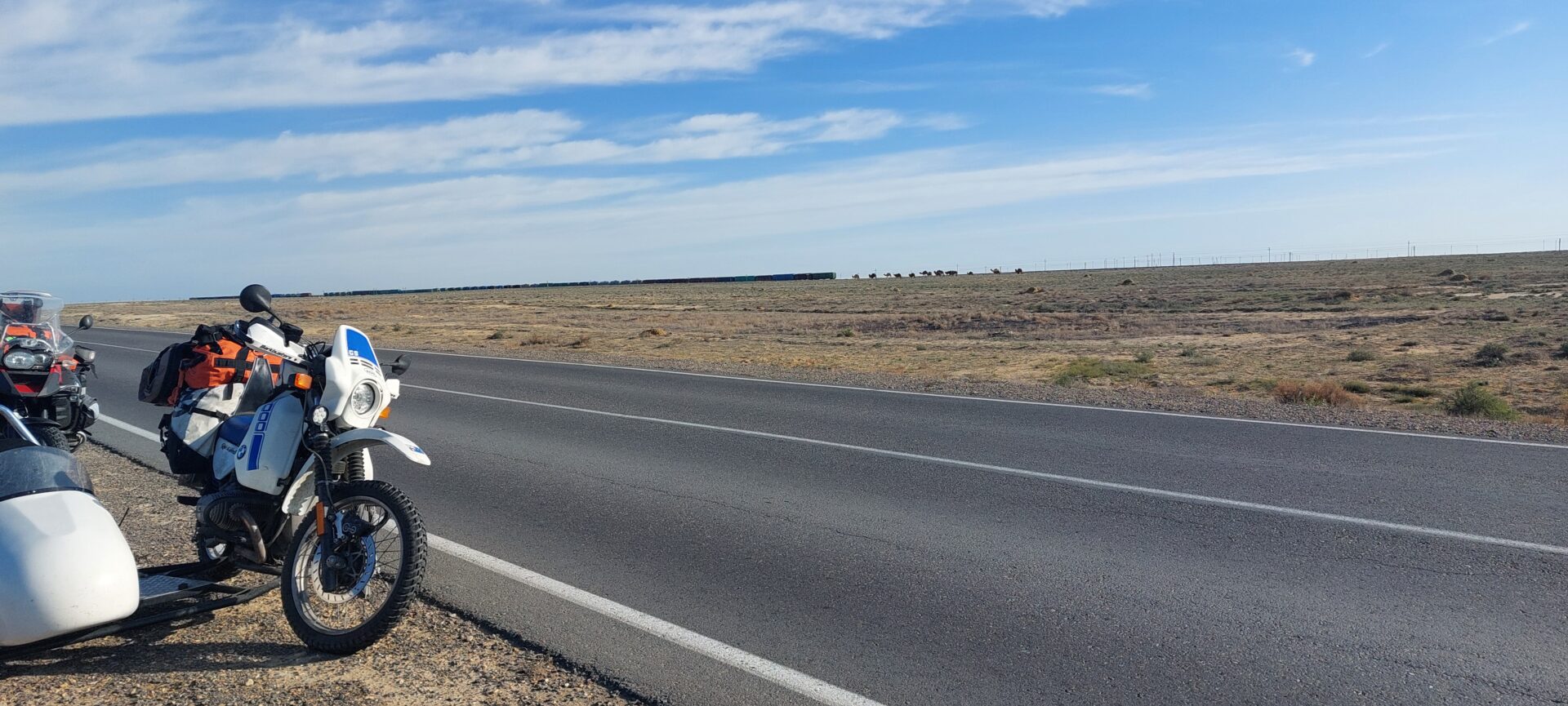
On our first proper day of riding, in heavy rain, we hit a stretch of highway where mud from a construction site had washed across the tarmac for a hundred metres. No warning sign. No margin. It felt like crossing a sheet of ice at speed, every instinct screaming to do nothing — no braking, no steering input, just pray the bike kept straight. A couple of days later, an oncoming bus overtaking on a road with no shoulder forced Paul off the tarmac at close to 100km/h, the sidecar wheel dropping off the edge before he brought it back. And then — the moment that stays with me most clearly — an oncoming KAMAZ truck, seeing he couldn’t complete his overtaking manoeuvre in time, pulled back in and immediately back out again, filling the road, relying on me to find the gap. We were eye to eye. I did find it, but it took me a while to breathe normally again.

Azerbaijan: Big Brother is watching
Baku has money for infrastructure, and it shows. It also has CCTV and speed cameras everywhere, and drivers who have learned to read the surveillance map rather than internalise its logic. Speed where you think you won’t be caught; observe the limit where you think you will. Compliance as a function of observation. This is a governance culture I recognise from thirty years of development work in post-Soviet contexts: when the state is experienced as an extractive instrument rather than a shared project, citizens route around it wherever they can.
We were told the traffic police had been instructed not to bother foreigners. Which means the traffic police are a revenue instrument aimed at citizens, not a safety instrument. We were invisible to the system — which is, of itself, a form of commentary.

Georgia: the oldest humanism, the newest fine
The Dutch riders we met coming the other way — three bikes, husband and wife and a friend — told us Georgia had been their least favourite country on the trip. They’d been fined immediately after entering, for an offence no local driver was cited for. We had our own version on the return from Poti: police chased us up the highway ramp claiming Paul hadn’t indicated leaving the roundabout. No local driver had indicated properly. Paul almost certainly had — he was leading, he needed to signal his intentions to me — but his indicator is small and half-hidden by the bedroll. We paid the minor fine via our host’s app. Our host advised us to fight it. We decided not to bother.
The pattern is clear: selective enforcement against those least likely to push back, as a way of demonstrating activity to superiors without upsetting locals. I’ve seen the same logic in procurement, in customs, in border management across the region. It’s not unique to Georgia. What is distinctive about Georgia is what sits beneath it: a selfconfidence bordering on arrogance, softened by a rough-edged humour, and underneath both a deep, old humanism — older, considerably, than what we tend to call European civilisation. The Georgian literary and philosophical tradition predates most of Western Europe’s institutional framework by centuries. Being fined on a highway ramp doesn’t change that. In the end, the ride to Goderdzi was my favourite day of the journey, and Batumi is definitely a place I want to revisit with my family.

Bulgaria, Romania, Hungary, Austria: the return
Bulgaria surprised us with its competence — the ferry port authorities spoke English rather than Russian and processed us efficiently. The border insurance not being available at our port of entry was a reminder that even when many things go smoothly, it’s sufficient if one doesn’t. The Nikopol ferry across the Danube — no queue, no wait, no border formalities at all — was one of the quietest pleasures of the whole return.
Romania was slower than expected: long villages, low speed limits, few places to stop. Craiova surprised us both — Paul saw Melbourne’s posh suburbs; I saw the wealthy hills above Graz.
Hungary: functional, charmless, under construction. Storks above the puszta. The OMV petrol station before the Austrian border felt, for the first time, like a genuine threshold.
Austria: Google took us through villages — well-kept, clean, good signage, surrounded by wind and solar farms. The Semmering, engineering marvel of the 19th century, soon to be retired by the tunnel that is the engineering marvel of the 21st. The schnitzel and beer in Kindberg tasted, I will not pretend otherwise, extraordinary.
